
Your paycheck lands, bills ping your inbox, and you still cannot say what your money is doing this month. You do not need a spreadsheet with 40 tabs. You need a one-page plan that points your money in the right direction and is simple enough to stick to on a tired Tuesday night.
Carl Richards argues for exactly that. His book is not a technical manual. It is a short push toward clarity, values, and behavior that you can actually keep. If you want a practical starter map for 2026, the book’s spirit pairs well with a 50/30/20 budget, a Roth IRA first savings priority, and one very plain rebalancing rule.
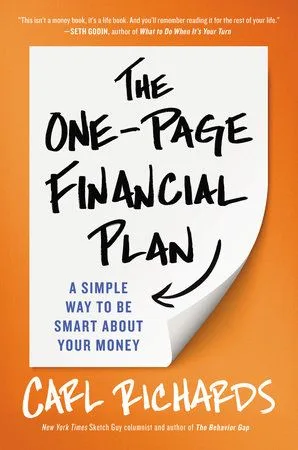
Quick summary box
- Core idea or theme of the book: A one-page plan that ties money to values and keeps action simple.
- Best use-case or reader situation: Beginners or rebooters who feel stuck, scattered, or overwhelmed by choices.
- Tone/style of the book: Calm, sketch-friendly, story driven, behavior focused.
- One realistic benefit: Helps you decide what to do next month without perfect data.
- One limitation or constraint: Light on tax specifics and detailed investment mechanics.
What the book really offers
Richards cuts through noise by asking a blunt question first: what do you want your money to do for you. He uses quick sketches and short prompts to reduce decision sprawl. The advice does not hinge on timing the market or clever products. It leans on defining a direction, then automating the boring parts so your default behavior is the right one.
For someone juggling limited income, rising rent, and irregular expenses, this approach matters. The plan lives on a single page you can revisit each season. It guides a few repeatable moves rather than a checklist you will abandon by March.
The trade-off is depth. You will not find line by line tax strategy, small business entity structure, or a tour of factor tilts. That is not a flaw if you need movement, not mastery, but it does set the boundary of the book’s usefulness.
A 2026 beginner setup inspired by the book
Here is a clean starting point that matches the book’s simplicity while giving you enough structure to act.
1) Budget with 50 - 30 - 20
Use your take-home pay. Allocate roughly 50 percent to needs, 30 percent to wants, 20 percent to saving and debt payoff. It is a blunt tool, but it creates a floor for saving even in noisy months. If your rent or debt pushes needs to 60 percent, compress wants first, not savings, and work back to 20 percent over a few months.
2) Roth IRA first - with one exception
Direct your first long term investing dollar to a Roth IRA. You fund it with after tax money and withdrawals in retirement may be tax free if rules are met. It is simple to understand and flexible if you truly need contributions back later. One exception matters: if your employer offers a 401(k) match, contribute enough to capture the full match before the Roth IRA. Free match dollars beat ideal account order.
Inside the Roth, keep it boring and low cost. Examples that fit: a total U.S. stock index like Vanguard Total Stock Market ETF - VTI with a 0.03 percent expense ratio, a total international fund like VXUS, or an all-in-one target date fund like Vanguard Target Retirement 2060. If you use Fidelity, their zero fee FZROX is an option. Most beginners do fine with a single target date fund to start.
3) A simple allocation and rebalancing rule
Pick an allocation you can sit with when markets drop 30 percent. A common starting point is 80 percent stocks and 20 percent bonds if you have a long horizon, or 70 percent and 30 percent if you prefer a smoother ride. Use broad funds like VTI - U.S. stocks, VXUS - international stocks, and BND - U.S. bonds. Costs matter more than clever slices.
Rebalance once per year on the same month, or when any piece drifts more than 5 percentage points from target. Example: if stocks target 80 percent and they reach 86 percent, move the excess back to bonds. Keep it mechanical. This stops risk from creeping while avoiding constant tinkering.
Final practical step: automate transfers on payday. Automate Roth contributions monthly. Automate bill pay. Reduce the number of decisions you owe yourself each month.
Who benefits most - and who likely will not
This book suits beginners who feel decision fatigue, couples trying to agree on a direction, and busy professionals who want a one page check-in process each quarter. It also helps anyone who has started and stopped three budgets and needs a design that survives real life.
It will not satisfy readers seeking tax optimization for RSUs, advanced real estate modeling, or solo 401(k) plan design. Entrepreneurs with irregular cash flow can still apply the process, but will need extra tools for reserves and quarterly taxes.
Standout ideas that carry weight
- Values before spreadsheets - pick a direction first, then numbers follow.
- Automate behavior - remove friction, not add willpower.
- Sketch your plan - a one page visual forces trade-offs and clarity.
- Accept being roughly right - perfect forecasts are a trap that slow action.
- Use guardrails - rebalancing bands and fixed savings rates prevent drift.
Turning the book into actions and habits
- Write a one sentence money purpose for 2026. Example: Build a 3 month cushion and invest 20 percent without drama.
- Set a 50 - 30 - 20 split in your bank using two checking sub-accounts for needs and wants. Route 20 percent directly to savings and investing.
- Open a Roth IRA at Vanguard, Fidelity, or Schwab. Fund it on the 1st of each month. Check the IRS site for current 2026 contribution limits.
- Choose one fund. A target date fund simplifies allocation and rebalancing inside the account.
- Schedule a 20 minute money check on the same day each month. Confirm transfers ran, rebalance only on your set date, and move on.
- Build an initial emergency buffer of 1 month expenses, then work toward 3 to 6 months.
Money habits worth installing this quarter
- Round up savings by a tiny notch each quarter, even 1 percent.
- Use a sinking fund for irregular costs like car repairs and travel.
- Keep investment costs under 0.10 percent when possible.
- Delete brokerage apps from your phone. Check once a month on desktop.
- Write a sell rule now. Example: never sell due to headlines or a 10 percent drop.
How it compares to other popular books
Compared to JL Collins’s The Simple Path to Wealth, Richards spends less time on index fund mechanics and more on decision behavior. If you want deeper investing specifics and a focus on VTSAX plus bond choices, Collins is stronger after you get moving.
Against Ramit Sethi’s I Will Teach You To Be Rich, this book is quieter and less tactic heavy. Sethi covers scripts, bank setup, and credit card systems in detail. Richards helps you decide what you actually want the system to achieve.
Versus Dave Ramsey’s Total Money Makeover, Richards is less rigid on debt sequencing and more balanced on investing while still encouraging simplicity. Ramsey’s intensity helps some readers pay off debt fast. Others may benefit from Richards’s softer, values led framing.
Light critique and realistic limits
The book’s strength is also its weakness. Simplicity leaves gaps. Self employed readers need more detail on quarterly taxes, SEP IRA or solo 401(k) choices, and irregular income buffers. Tax location trade offs between Roth, traditional, and HSA deserve more than a few pages.
The U.S. centric lens is clear. International readers will need to translate account types and allowances to local systems. Finally, some readers may want clearer guidance on setting stock and bond splits by age and risk tolerance. The book offers nudges, not a firm glide path.
Common mistakes this book can help you avoid
- Waiting for perfect numbers before saving. Direction beats delay.
- Chasing hot funds. A low cost index core wins more often.
- Skipping the employer match to fund a Roth. Capture the match first.
- Rebalancing every week. Yearly or 5 percent bands are enough.
- Letting lifestyle creep swallow the 20 percent. Automate increases.
FAQ
Is the 50 - 30 - 20 budget realistic if my rent is high?
It can be tight. Treat 50 percent as a target, not law. Push wants down, raise income where possible, and phase toward 20 percent saving by raising 1 to 2 percent each quarter until you get there.
Should I fund a Roth IRA if I have high interest debt?
If the debt rate is double digits, prioritize paying it down while at least capturing any 401(k) match. Once the rate drops below a mid single digit, blend in Roth contributions. Avoid binary all or nothing thinking.
What if the Roth IRA contribution limits change in 2026?
They may. Set a monthly transfer based on a conservative estimate, then true up in December after checking IRS guidance. The habit matters more than the exact ceiling.
Which funds work for a one fund Roth IRA setup?
Target date funds like Vanguard Target Retirement 2060 or Fidelity Freedom Index 2060 keep costs low and handle bonds for you. If you prefer a two fund setup, VTI plus BND is clean and cheap.
How do I automate rebalancing without constant work?
Use a target date fund that rebalances internally, or set calendar rebalancing once per year. If you must do it manually, add a 5 percent drift rule and only act on your scheduled review day.
Is Roth or traditional better for me?
It depends on current and future tax brackets, which are uncertain. Beginners often do well starting with Roth for simplicity, then revisiting annually as income changes. Diversifying tax buckets is a valid strategy.
Quick verdict
Read it if your finances feel scattered and you need a reset that fits on paper. Buy it if you value short, repeatable prompts and want a nudge to review your plan each quarter. Borrow it if you already run a low cost index portfolio and only need a refresher on behavior.
A grounded close
In practice, simple beats flashy - write the page, automate it, and get back to your life.